Robotics · Simulation
Imitation learning study on a simulated Franka Panda
A simulated Franka Panda learns cube pick-and-place by behavior cloning and by a Diffusion Policy written in plain PyTorch, with a SAC reinforcement learning baseline for comparison.
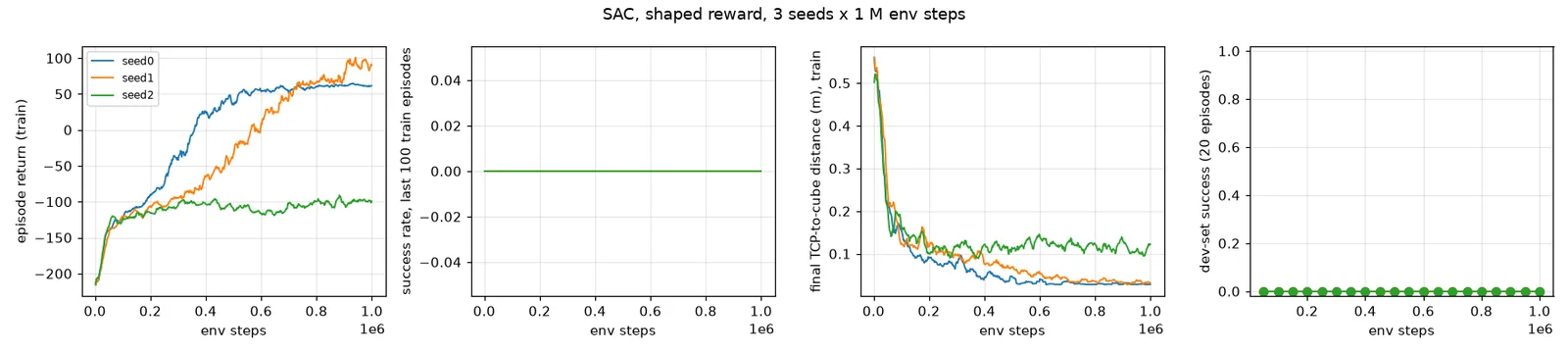
The environment, dataset tooling, policies and SAC runs are finished. The multi-seed held-out evaluation, milestone 7 of 8, is built but not yet run, so there is no held-out result. So far, untuned SAC scored 0% on three seeds after 1M steps each, and a single-seed, 20-episode dev-set check had each imitation method at 90 to 100%.
The problem
A Franka Panda arm in MuJoCo has to grasp a 4 cm cube and leave it resting in a bin. The cube starts at a random position and yaw inside a 16 by 16 cm square.
I wanted to compare behavior cloning and Diffusion Policy on that task under one training protocol, with SAC as the reinforcement learning baseline. It had to train on a laptop: an Intel Arc 140V integrated GPU (iGPU), no CUDA.
What I built
Actions arrive at 20 Hz: a tool pose delta of at most 1 cm and 0.05 rad, plus a gripper command. Two 96 by 96 pixel cameras deliver frames that are 20 ms old.
Demonstrations come from a scripted expert: 220 episodes, all successful, in a Zarr format I wrote. Each stream is logged on its own clock, then aligned to the control ticks. Replaying logged actions reproduced the simulator state bit for bit on the five episodes checked.
The policies are plain PyTorch. Behavior cloning predicts a chunk of 16 actions and executes 8, and Diffusion Policy uses the 1D conditional UNet of Chi et al. Both share one encoder, optimizer and schedule, so only the head and loss differ.
The imitation policies train on the iGPU through PyTorch's XPU backend. An older driver returned 506 of 1023 entries from torch.nonzero with no error, so the code refuses the device until a self-check passes.
- Dataset validator and LeRobot export
- Evaluator with 10 lockstep environments and per-episode seeding
- Stable-Baselines3 SAC baseline on the same environment
Results
Milestones 0 to 6 are done. None of the numbers below is a held-out result.
Untuned SAC with the planned shaped reward scored 0% success after 1M environment steps on each of three seeds, at 9.1 to 9.5 hours per seed. Two seeds learned to close the gripper on the cube for the +1 per step grasp reward, and none carried it to the bin.
The dev-set check used 20 poses and one seed per method. Chunked behavior cloning scored 20 of 20 from state and from images, and single-step behavior cloning 18 of 20. Diffusion Policy scored 19 of 20 from state and 18 of 20 from images. Twenty episodes resolve nothing finer than 5%, and I do not count this as a result.
Limits and next steps
Milestone 7 is the real experiment: 109 training runs and 169 held-out evaluations, with up to five seeds per method and bootstrap confidence intervals. The queue that runs them is written, but no run has started. The analysis plan was committed before any learned policy ran on a held-out pose.
A pre-launch re-read of the training code found two bugs that affected the dev-set runs. Initial weights ignored the seed, and training windows were shifted by one step. Both are fixed, and milestone 7 reuses none of those runs.
All training data comes from a deterministic scripted expert. I recorded one human teleoperation episode and skipped the planned 220, so the study cannot show Diffusion Policy on varied human data. Nothing has run on a real robot.
Ask a question about this project
An AI assistant answers from this site's text. It can be wrong; this page is the source.