







Deniz Gursoy Electrical Engineering at UPenn · Hardware Design, Robotics, and Embedded Systems
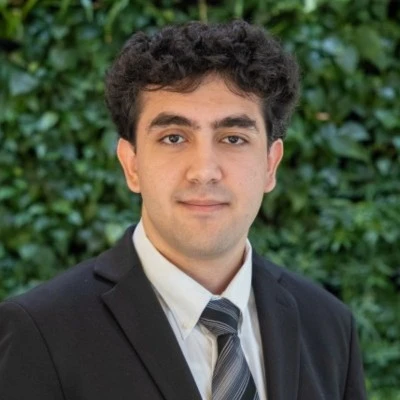
Portrait of Deniz Gursoy

I like building hardware end to end, from designing the first schematic to validation testing the final product.

I'm an electrical engineering student at the University of Pennsylvania, class of 2028, with a minor in computer science. Most of my work is embedded hardware and controls: sensor boards, control panels, PLC logic and firmware.

In summer 2026 at SpaceX I designed, wired and commissioned four 480 V control panels on the Raptor engine program. At Penn I lead controls on Penn Hyperloop's tunnel boring machine and co-lead the prosthetic arm project at Penn ADAPT. I'm looking for internships and research for spring or summer 2027 in embedded systems, robotics, controls and hardware.

Autonomous tunnel boring machine controls
Degree
B.S.E. in electrical engineering, minor in computer science, University of Pennsylvania, expected May 2028
Summer 2026
SpaceX, Electrical & Controls Engineering Intern on the Raptor engine program, Hawthorne, CA
Research
Modular Robotics Lab (GRASP Lab), capacitive joint-angle sensing for the ABOT modular robot, Feb to Sep 2026
Teams
Penn Hyperloop (controls engineering lead), Penn ADAPT (project co-lead), Penn IEEE (president and co-chair)
Looking for
Internships and research for spring or summer 2027, in embedded systems, robotics, controls and hardware

Projects

17 projects. Each has its own page with results and limits.

Autonomous tunnel boring machine controls

PLC logic, three drives and 480 V power for Penn Hyperloop's 1,000-lb boring machine. We placed second at the 2026 Not-a-Boring Competition.

Hardware buildSep 2025 to nowIn progress

Simulated quadruped that learns to walk with PPO

A simulated Unitree Go1 learns to walk from a shaped reward alone. The policy walked at 1.90 m/s and recovered from 39 of 40 pushes of 100 N.

SimulationJul 2026

FreeRTOS battery-module CAN node, simulated

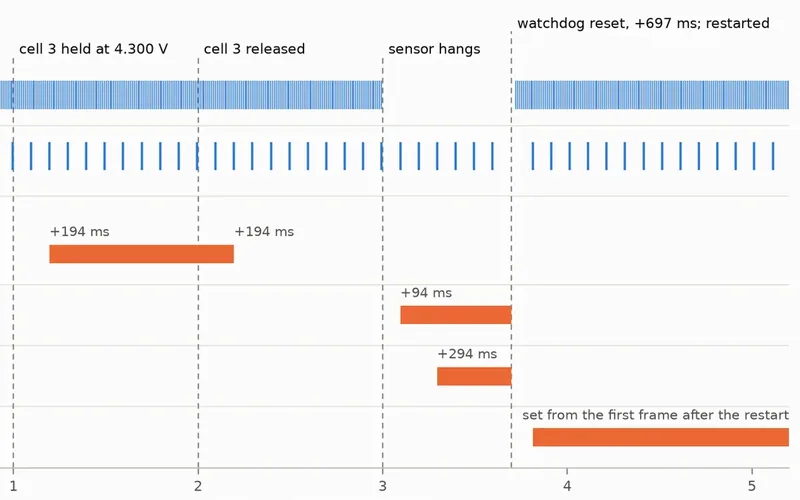
A FreeRTOS battery telemetry node, simulated on a laptop, with protected CAN frames and two watchdogs. Phases 0 to 3 of 8 done; 978 tests pass in CI.

SimulationNov 2026 to nowIn progress

Imitation learning study on a simulated Franka Panda

Behavior cloning and Diffusion Policy on a simulated Panda arm, in progress. A SAC baseline scored 0% after 1M steps on each of 3 seeds.

SimulationOct 2026 to nowIn progress

8-channel EMG acquisition system for a prosthetic arm

Eight 24-bit ADS1291 modules on one SPI bus, designed to read muscle signals for a prosthetic arm. A one-channel capture holds 20,000 samples in 10 s.

Hardware buildSep 2025 to nowIn progress

QuoteDesk: a quoting assistant for machine shops

Team hackathon build. Gemini reads a buyer's email and PDF drawing into 10 spec fields with quoted evidence, and plain code decides what is missing.

SoftwareOct 2026

Simulated two-ECU CAN network on Zephyr

Two simulated Zephyr ECUs trade CRC-protected CAN frames through a gateway that injects faults. 23 of 23 system tests pass, also with a Rust sensor.

SimulationOct 2026

Nonlinear MPC for a simulated quadrotor

A simulated quadrotor flies three obstacle courses under nonlinear MPC and under PID. The MPC finished 3 of 3 with no contact, the PID 2 of 3.

SimulationJul 2026

Simulated 48-cell battery management system

A simulated 48-cell pack and its battery management system. From noisy telemetry, an unscented Kalman filter tracked state of charge to 0.44% RMSE.

SimulationJul 2026In progress

Simulated systolic-array MNIST accelerator in SystemVerilog

A 4×4 systolic array runs INT8 MNIST inference in simulated RTL. All 2,000 logits and 9,600 hidden activations match the golden model.

SimulationJul 2026

CartScout: an RL environment for browser shopping agents

Team hackathon build: a small model browses real retailer pages and returns a cited pick without buying. 22 of 40 held-out tasks scored 0.70 or more.

SoftwareJun 2026

STM32 flight controller PCB design for competition UAVs

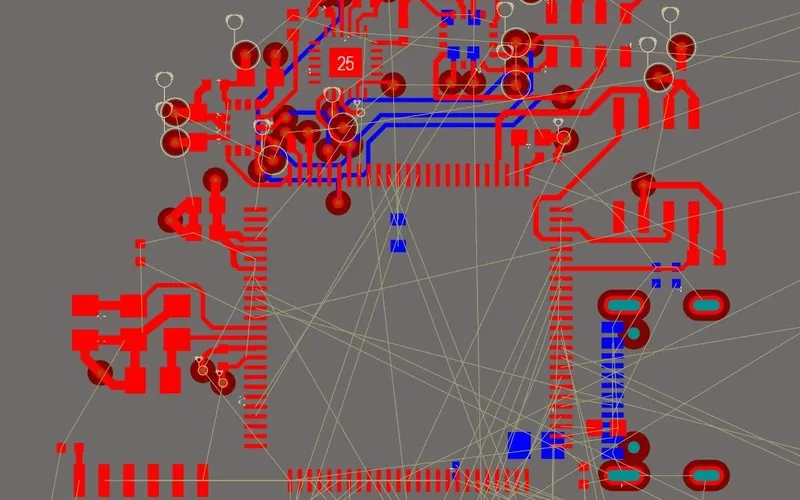
A flight controller board designed in Altium around one STM32F427 by a team of six. It was partly routed in December 2025 and fabricated after that.

Hardware designSep 2025 to Jan 2026

NaviGlass: head-worn object alerts on a Raspberry Pi 4

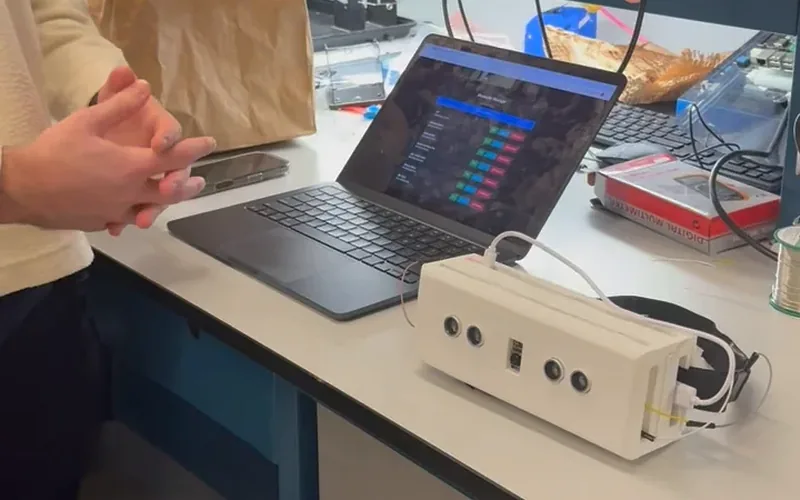
A head-worn Raspberry Pi 4 names the objects its camera detects and vibrates on the side they are on. Team course build from $83 of listed parts.

Hardware buildNov to Dec 2025

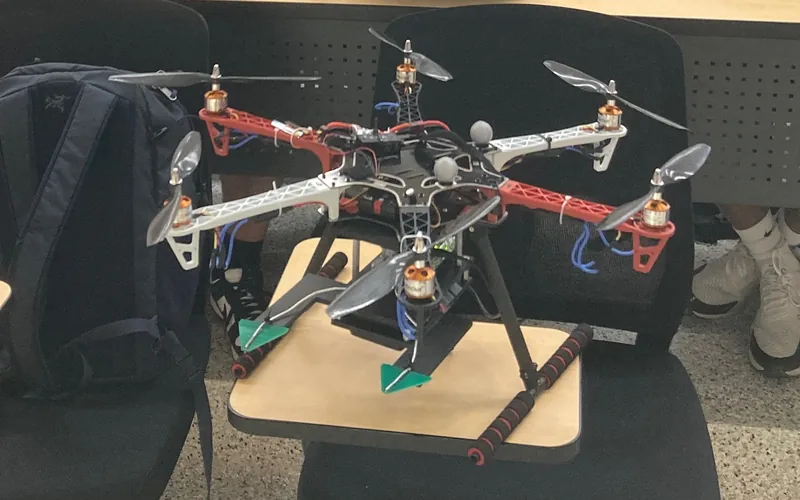
Hexacopter for synthetic aperture radar imaging

A team-built six-rotor drone that carries a PulsON 440 radar. My Python code forms SAR images by backprojection, at a resolution under 10 cm.

Hardware buildJun to Aug 2025
5service modules I added, 1,536 lines in total

MERN expense tracker with rule-based analytics

A MERN personal finance app whose base follows a public tutorial. I added five rule-based analytics modules, including a health score and badges.

SoftwareJul to Aug 2025

Backtested PPO trading agent with an HLS inference draft

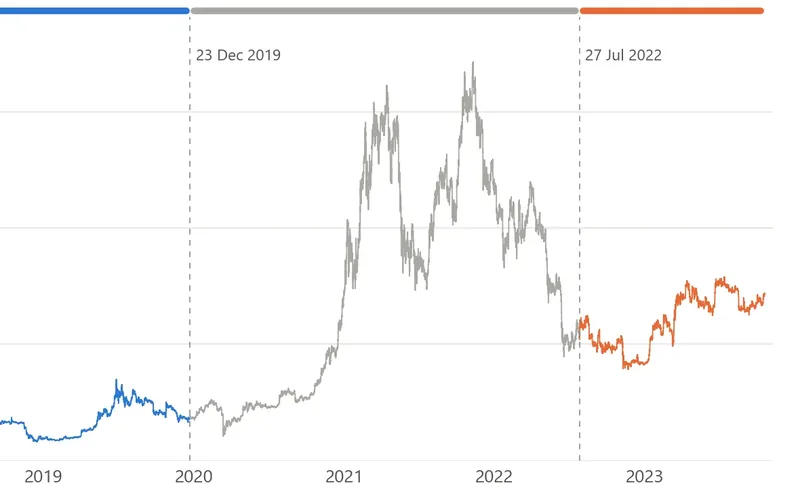
A PPO agent trades hourly BTCUSDT in a backtest, with an unsynthesized HLS C++ draft of its network. It returned 36.37%; holding BTC returned 35.93%.

SimulationJul 2025

Autonomous racecar for the MIT Beaver Works Grand Prix

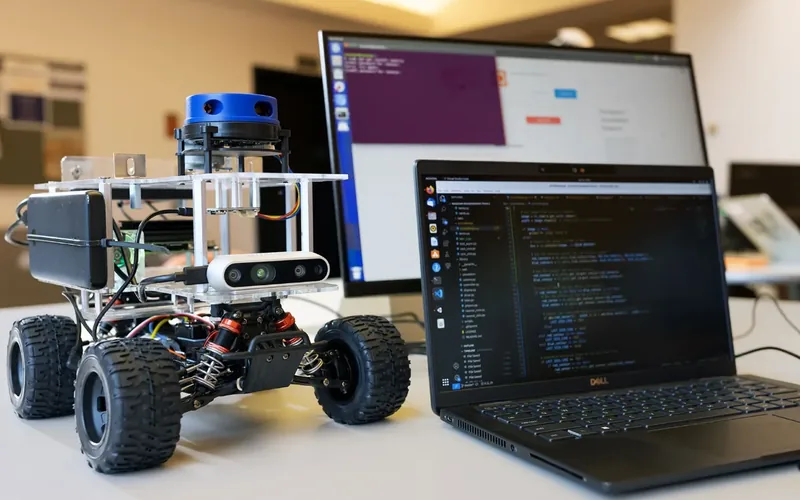
A scale-model car that drives a 9-section obstacle course on LIDAR, camera and IMU data. We placed first in our division and third of 11 teams at MIT.

Hardware buildJun to Aug 2023

Experience

Internships and research, 2023 to 2026.

SpaceX

Electrical & Controls Engineering Intern · Hawthorne, CA

May to Aug 2026

  • I designed, wired and commissioned four 480 V industrial control panels for a manufacturing program.
  • I wrote the PLC logic and drew the EPLAN schematics for systems that validate hardware ahead of Raptor engine production.
  • I supported cross-functional validation work before production, which contributed to a 45% cost reduction and about $75 million in savings.
  • I also built a PLC function-block system to replace a legacy alarm-handling process that covered more than 200 fault codes.

Modular Robotics Lab, GRASP Lab

Undergraduate Research Assistant · Philadelphia, PA

Feb to Sep 2026

  • I designed capacitive sensing circuits that detect joint angle on the ABOT modular robot, working under Prof. Mark Yim.
  • The circuit is a Schmitt trigger relaxation oscillator built around an OPA277 op-amp. It was built to give the robot real-time feedback on its own joint positions, and it was tested on the robot.

Venture Lab, stealth AI and health tech startup

LLM Operations Intern · Philadelphia, PA

Sep to Dec 2025

  • I worked with an AI and health tech startup in stealth at Venture Lab, on its real-time health analytics platform.
  • I built features with React Native, Supabase and FastAPI.
  • I integrated ML-generated insights that analyze a user's symptom data and return personal health patterns in under 3 seconds.

Syracuse University, College of Engineering

Robotics Systems Engineering Intern · Syracuse, NY

Jun to Aug 2025

  • With a team, I built a hexacopter for synthetic aperture radar imaging, integrating a PulsON 440 radar with a Pixhawk flight stack and a Raspberry Pi.
  • I optimized the powertrain, which raised flight stability by 20% during autonomous data collection.
  • I wrote the Python signal processing, which forms the images by backprojection with motion compensation. The images reached a resolution under 10 cm, and image reconstruction latency fell by 40%.
  • Read the project page

Stony Brook University

Simons Summer Research Intern · Stony Brook, NY

Jun to Aug 2024

  • I ran 3,600 ns of atomistic molecular dynamics simulations in LAMMPS with the CHARMM36 force field to quantify the energetics of PFAS insertion into membranes.
  • The simulations showed a free energy gradient of −9.0 to −17.2 kT that drives deep membrane penetration, a mechanism behind the bioaccumulation of these "forever chemicals".
  • I'm a co-author on the paper, published in Langmuir in 2025.
  • Read the paper in Langmuir

MIT Lincoln Laboratory

Team Captain, Beaver Works Autonomous Racecar Grand Prix · Syracuse, NY and Cambridge, MA

Jun to Aug 2023

  • I captained a team of five high school students in the Beaver Works autonomous racecar Grand Prix. We placed first in the international division and third of 11 teams overall. The course was taught through Orange Works, a program at Syracuse University, and the final was at MIT.
  • We programmed a scale-model car to drive a 9-section obstacle course without a driver.
  • The Python stack fused LIDAR and IMU data, recognized AR markers with OpenCV and steered with a PID controller. Obstacle response stayed under 100 ms and the car finished with zero collisions.
  • Read the project page

Teams at Penn

Student teams where I build hardware and lead people.

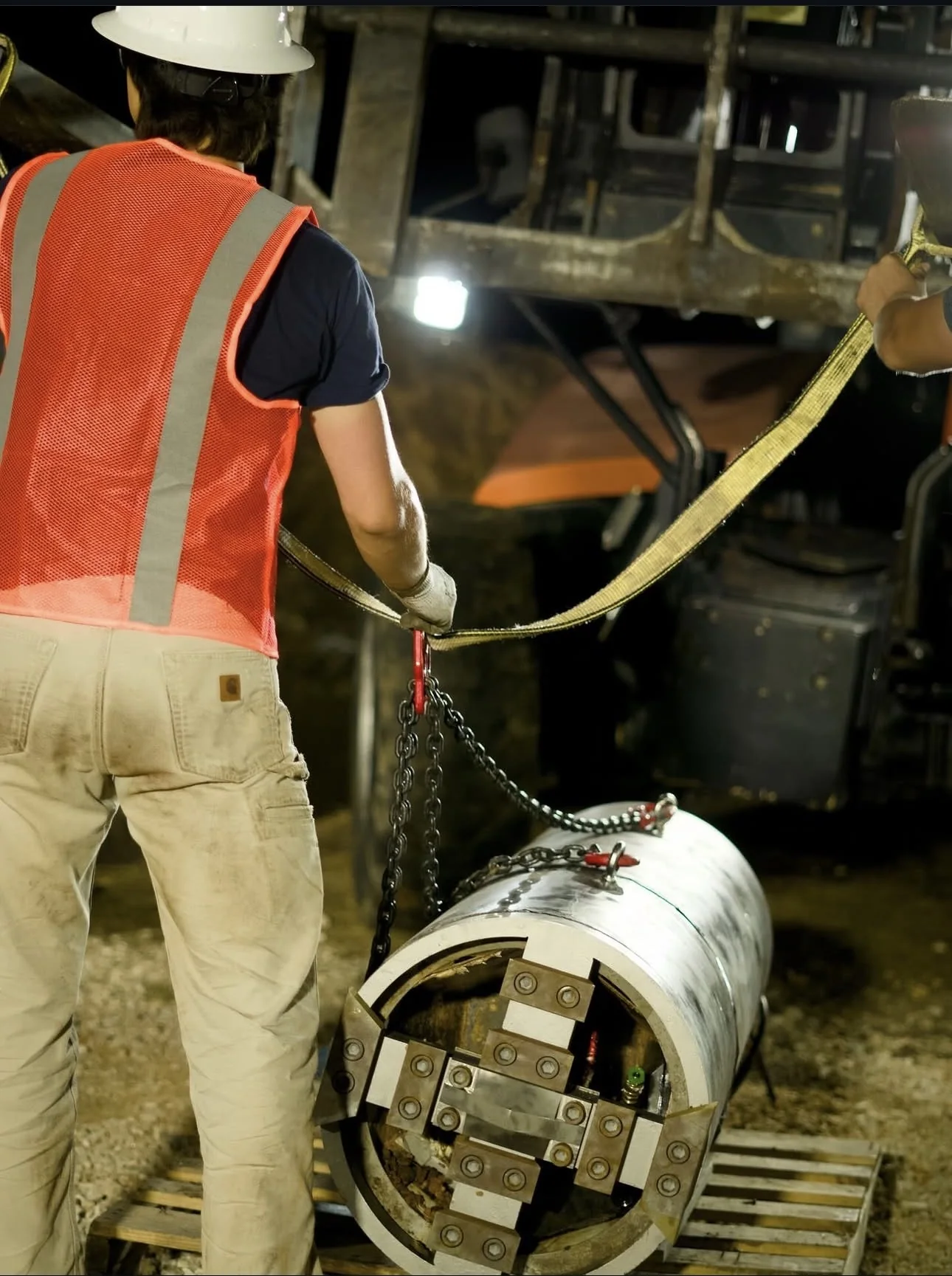
A person in a hard hat and orange vest holds a lifting strap chained to the tunnel boring machine, which rests on a pallet at night.

Penn Hyperloop builds an autonomous tunnel boring machine for The Boring Company's Not-a-Boring Competition. The team has about 40 members across mechanical, electrical, controls and navigation subteams. I joined in September 2025 as a power and controls engineer. Our 1,000-lb machine placed second at the 2026 competition. Since August 2026 I have led controls engineering for the 2027 machine, with a subteam of five.

  • I owned the PLC logic on the 2026 machine. I programmed a Siemens S7-1200 PLC in TIA Portal to run the autonomous drilling state machine. I configured the three Siemens G120 drives and built the PROFINET and Modbus RTU communications.
  • I designed the 480 V three-phase power distribution that replaced the 2025 machine's 240 V supply. The 2025 breaker trips stopped after we installed a line reactor on the drive input to cut inrush and harmonic current. A hardwired chain of E-stops, a safety relay and the main contactor removes drive power independently of the PLC program.
  • Full-system testing had to wait for the competition site in Bastrop, Texas. That meant debugging in the field under time pressure. We hit GFCI trips, Modbus communication errors and drive overheating, and we contained all three on site.
  • For 2027 I own the steering electronics, the split between the PLC and a microcontroller layer, and the safety fault responses. Steering uses four Progressive Automations PA-HD3A linear actuators with Hall-effect position feedback. The navigation subteam is adding three IMUs on a separate microcontroller near the actuators. I am defining the competition-required telemetry GUI as one dashboard: drive status, actuator positions, IMU orientation, faults and power data.
  • I lead a controls subteam of five and onboard new members each year. I wrote and taught a 90-minute PLC fundamentals workshop with hands-on exercises and homework. A follow-up session covered our machine's setup and code.
Read the project page

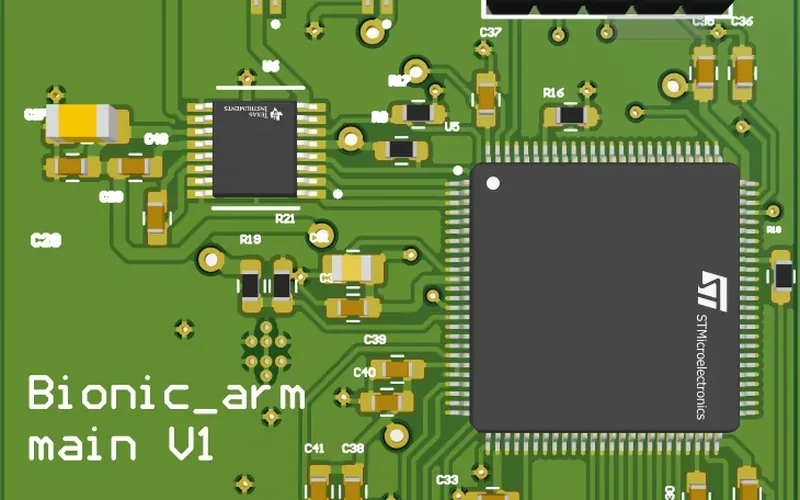
Penn ADAPT builds assistive and adaptive technology. I co-lead its prosthetic arm project, an 8-channel surface EMG acquisition and actuation system designed to turn muscle signals into motion. I wrote the acquisition firmware and contributed to the schematic and layout of the sensor modules in Altium. EMG signals have driven the arm. The STM32H730 integration and the move to two servos are not finished.

  • The sensing side is designed as eight modules, each with a 24-bit ADS1291, on one 10 MHz SPI bus. Each module has its own chip-select line, and the START pins are tied so every channel samples together. One shared bus replaced eight microcontroller peripherals and simplified routing.
  • The main board's STM32H730 is a Cortex-M7, chosen for headroom to run on-board TinyML gesture classification later. The board has a DRV8874 H-bridge for the linear actuator and PWM outputs for a dual-servo joint stage. A 2S LiPo feeds 12 V, 6 V and 3.3 V rails. The 3.3 V sensing rail is kept separate from the actuator supply.
  • I implemented the PWM and control interfaces, with current sensing and fault feedback from the H-bridge. I also built a modular Raspberry Pi Pico interface for actuator prototyping and per-user calibration.
  • I used a 4-layer stackup with dedicated ground and power planes. During sensor bring-up I traced a repeating artifact to SPI clock coupling into the analog front end. I rerouted the sensitive traces and the artifact disappeared.

Read the project page

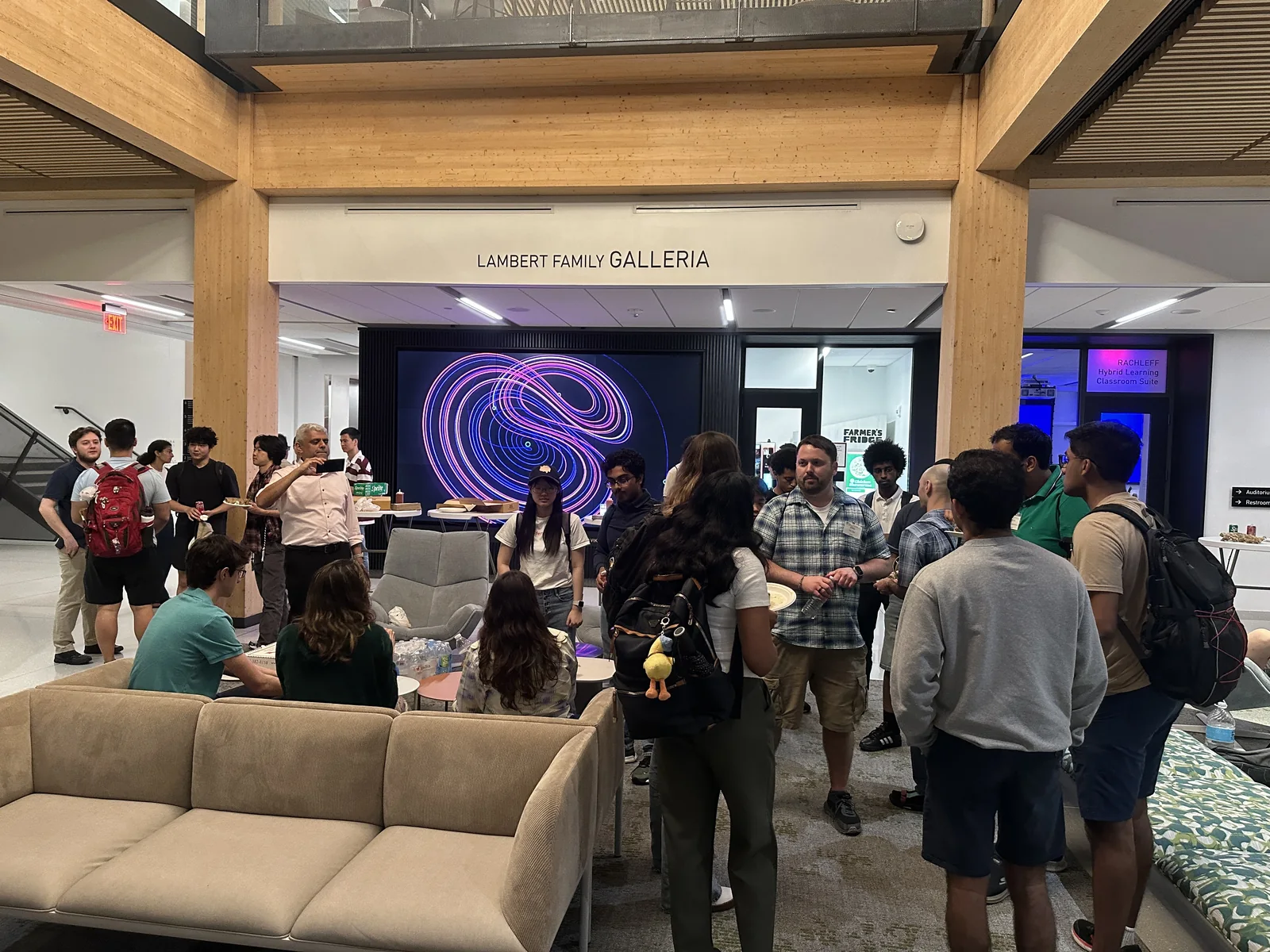
About twenty people stand talking near tables of food in the Lambert Family Galleria at a Penn Engineering alumni social.

Penn IEEE is the University of Pennsylvania's student branch of IEEE. It connects about 180 members across electrical, computer and systems engineering with industry and faculty. I have been president and co-chair since January 2026, and I lead a board of five officers.

  • I organized a fireside chat with Dr. Nader Engheta, the H. Nedwill Ramsey Professor at Penn. He is known for his work on metamaterials and optical computing, and about 50 people attended.
  • I organized and co-moderated a joint alumni panel with Penn Architechs on career paths in hardware and software. Nine panelists from NVIDIA, Apple, CrowdStrike, Lutron and other companies also covered recruiting and graduate school decisions.
  • I helped draft new constitution articles that formalize officer roles, elections and succession, so the branch runs consistently year to year. I also prepared our materials for the IEEE Student Activities Conference.
  • We run recurring technical workshops on topics like PCB design, embedded systems and FPGAs, plus industry info sessions and company tech talks. Social and mentorship events pair underclassmen with upperclassmen, and past events include a Penn Engineering alumni social.
  • Active membership has grown from 100 to 180, and we secured $1,000 in sponsorship and university funding. We have hosted six events so far in the 2026 to 2027 academic year.
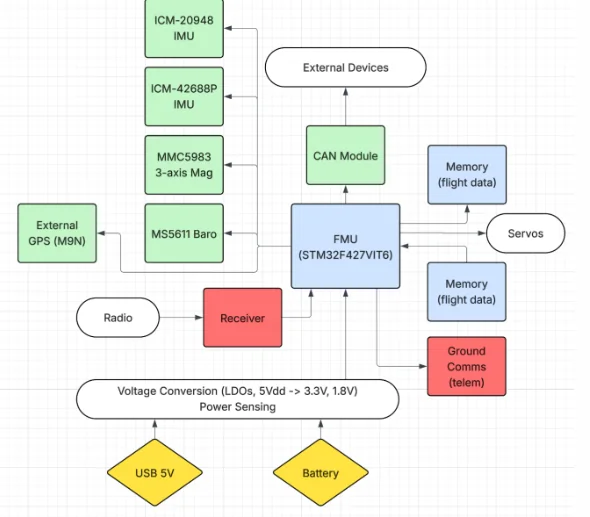
Block diagram of the flight controller: an STM32F427 unit connected to two IMUs, a magnetometer, a barometer, GPS, a CAN module, two memories, a receiver and power conversion.

At Penn Aerial Robotics I was one of six students who designed a custom STM32-based flight controller in Altium Designer for the team's competition UAVs. The goal was lower cost and weight than a commercial Pixhawk. I was on the team from September 2025 to January 2026.

  • The targets against a commercial Pixhawk were a cost reduction of more than 50% and a weight reduction of 30%.
  • I designed the power management, which converts USB or battery input to 5 V, 3.3 V and 1.8 V rails.
  • I also designed the two memory modules for flight data logging and the power sensing. The board was fabricated.

Read the project page

Awards

16 awards and honors, 2023 to 2026.

2026

  • GE Aerospace L.I.F.T. Summit selectee

    GE Aerospace · May 2026

    I was one of fewer than 100 students chosen from more than 3,800 applicants. The Leaders Innovating Flight for Tomorrow summit is a three-day invite-only recruiting event at GE Aerospace headquarters in Cincinnati.

  • Second place, 2026 Not-a-Boring Competition

    The Boring Company · Apr 2026

    With Penn Hyperloop. I wrote the PLC program and designed the 480 V power path for the 2026 machine.

    Read the project page

2025

  • Class of 2025 commencement speaker (valedictorian)

    Fayetteville-Manlius Senior High School · Jun 2025

  • Regeneron International Science and Engineering Fair (ISEF) finalist

    Central New York Science and Engineering Fair · Mar 2025

    The Central New York fair's acceptance rate to ISEF was about 3%.

  • American Chemical Society Central New York Section Award

    Central New York Science and Engineering Fair · Mar 2025

    Given to the student who shows excellence in understanding and using chemistry principles.

  • Regeneron US Metric Association Award

    Central New York Science and Engineering Fair · Mar 2025

    Given to the student who shows excellence in quantitative measurement using the SI system.

  • Third place, Lockheed Martin Code Quest

    Lockheed Martin · Mar 2025

    Advanced division, about 20 teams, at a statewide meet in Owego, NY.

  • National Spanish Exam gold medal, twice

    American Association of Teachers of Spanish and Portuguese · Feb 2025

    I scored in the 95th percentile or higher of test-takers in the United States.

  • National Merit Scholarship finalist

    National Merit Scholarship Corporation · Feb 2025

    About 1% of entrants become finalists.

2024

  • Syracuse.com Best & Brightest award

    Syracuse.com · Nov 2024

    I was one of 23 high school seniors recognized across 10 Central New York counties for academics, activities and community work. The selection used essays and recommendations.

  • Poster presenter, MIT Undergraduate Research Technology Conference

    Massachusetts Institute of Technology · Oct 2024

    I presented my computational study of how PFAS chemicals interact with human cell membranes.

  • AP Scholar with Distinction

    College Board · Jul 2024

    An average of at least 3.5 across all AP exams taken, with 3 or higher on five or more.

  • Bank of America Student Leaders selectee

    Bank of America · Apr 2024

  • Fifth place, Cornell High School Programming Contest

    Cornell University · Apr 2024

    Tied for fifth of 100 teams across the Cornell Tech and Ithaca sites.

  • National Rural and Small Town Recognition Program awardee

    College Board · Jan 2024

    For rural and small-town students who score in the top 10% of their state on the PSAT and meet a grade threshold.

2023

  • First in the international division and third overall, MIT Beaver Works Autonomous Racecar Grand Prix

    Massachusetts Institute of Technology · Aug 2023

    My team placed first among the international-division teams, which came from Syracuse University, Japan and Greece, and third of the 11 teams of five that competed on MIT's campus.

    Read the project page

Skills

Firmware
C, C++17, Rust, Zephyr RTOS, FreeRTOS, CAN and SocketCAN, STM32, ESP32
Hardware
Altium Designer, EPLAN, 480 V control panels, Variable frequency drives, SystemVerilog, FPGA synthesis with Yosys, Raspberry Pi, Pixhawk
Controls
Siemens S7-1200 PLC, TIA Portal, PLC function blocks, Modbus RTU, PID control, Nonlinear MPC with CasADi, Unscented Kalman filter
Robotics and learning
Python, PyTorch, MuJoCo, Stable-Baselines3, PPO, OpenCV, LIDAR

Education

B.S.E. in electrical engineering, minor in computer science, University of Pennsylvania, School of Engineering and Applied Science, Aug 2025 to May 2028 (expected).

Relevant coursework

Fall 2026 in progress

  • CIS 2400 Computer Systems Architecture
  • ESE 2150 Electrical Circuits and Systems
  • ESE 2180 Electronic, Photonic, and Electromechanical Devices

Spring 2026

  • CIS 1200 Programming Languages and Techniques I
  • ESE 1120 Engineering Electromagnetics
  • ESE 2030 Linear Algebra with Applications to Engineering and AI
  • ESE 2240 Signal and Information Processing

Fall 2025

  • ESE 1110 Intro to Circuits, Signals and Embedded Systems
  • MATH 1410 Multivariable Calculus
  • PHYS 0150 Principles of Physics I: Mechanics and Wave Motion

Email me about internships and research.

I am looking for internships and research for spring or summer 2027 in embedded systems, robotics, controls and hardware. Email is the fastest way to reach me.

dcgursoy07@gmail.com